Every World Cup has a ball controversy. The Jabulani's erratic flight ruined the 2010 tournament's opening week. The Al Rihla's unpredictable dip in thin South American air became a subplot to Qatar 2022. Adidas has spent the last decade trying to engineer its way out of that reputation. With the Trionda — the official match ball for the 2026 World Cup — it is making its most ambitious claim yet: a single ball consistent enough to behave identically in Vancouver, Mexico City, and Miami, across temperature ranges, altitude variations, and humidity levels that no previous World Cup ball has ever had to navigate.
Whether it succeeds is a question that will be answered in stadiums from June 11 onwards. What we can already say, based on aerodynamic testing and the engineering choices behind it, is that Adidas has understood the problem correctly — and made decisions that are genuinely different from anything tried before.
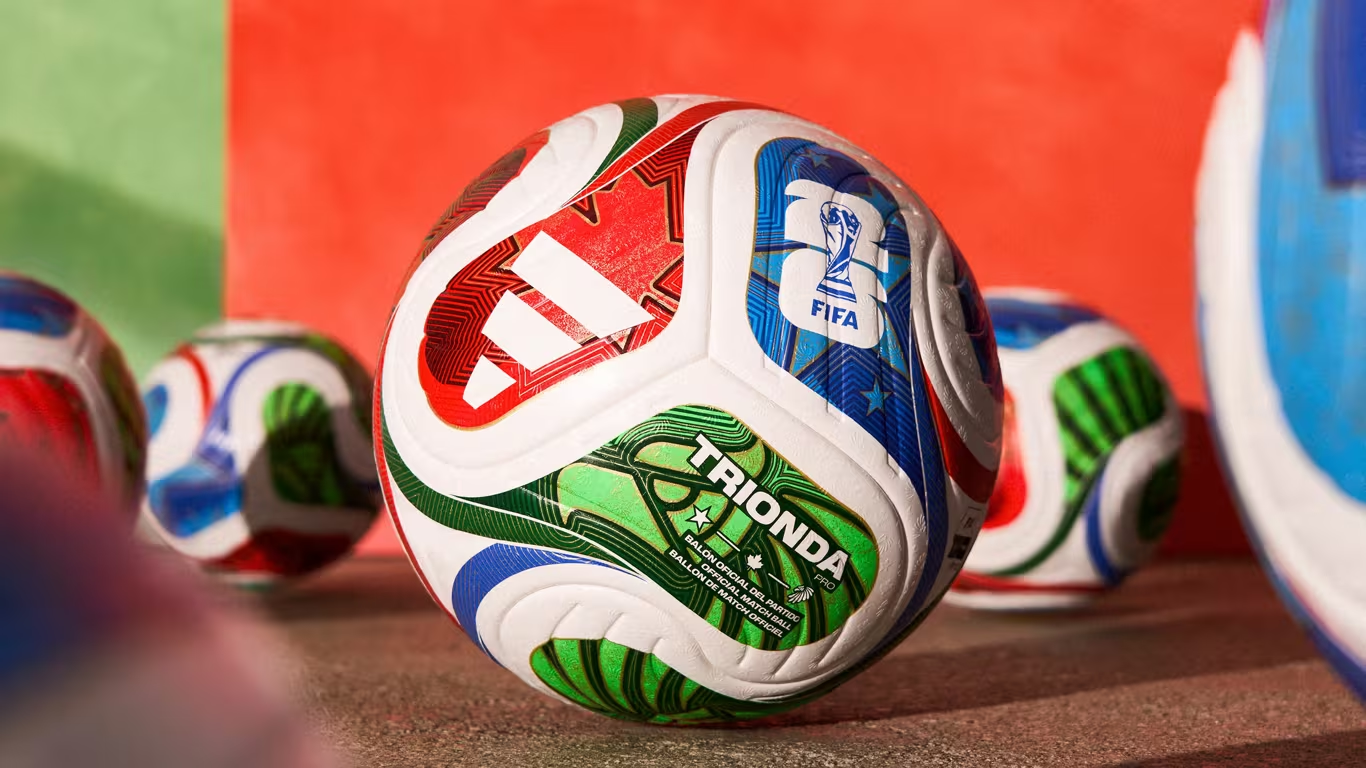
What the Name Tells You
The word Trionda fuses two Spanish roots: tri (three) and onda (wave). It is a direct reference to the three host nations and the fluid, wavelike geometry that defines the ball's surface. For the first time in tournament history, a World Cup ball has had to represent three countries simultaneously rather than one. The design solution is not a compromise — each nation gets its own panel colour and its own national symbol.
The three panels converge at the centre of the ball to form a triangle — the three nations meeting at a single point. Gold accents tie the design together, referencing the World Cup trophy itself. Adidas football general manager Sam Handy called it the most visually playful World Cup ball they have ever made. That may be true. But the visual identity is almost incidental to what the Trionda is trying to solve structurally.
Four Panels: A Record Low
The panel count of a football is one of the most consequential engineering decisions a manufacturer can make. Fewer panels mean fewer seams, which in theory means a smoother surface, more predictable airflow, and a more consistent flight path. In practice, it is never that simple — the Jabulani proved that a near-seamless ball can be aerodynamically catastrophic if the surface texturing does not compensate correctly.
The four-panel construction gives the Trionda a tetrahedron-like internal geometry — a shape that, on paper, produces maximum spherical symmetry. This is where the comparisons to the Jabulani become unavoidable. That ball was also engineered for symmetry, via eight moulded panels, and its near-perfect roundness turned out to be the source of its problems: when kicked with low spin, it moved erratically because the air struck it differently at different orientations. The critical-speed range — the point at which drag drops sharply — was so high (roughly 49–60 mph) that it sat squarely within free-kick and crossing territory, causing unpredictable mid-flight deceleration.
Adidas has learned that lesson. The Trionda is not trying to be smooth. It is intentionally rough.
The Aerodynamics: Deliberately Rough, Deliberately Low
Wind tunnel testing at the University of Tsukuba, comparing the Trionda against its four immediate predecessors, revealed something counterintuitive: despite having fewer panels and therefore less total seam length, the Trionda behaves as aerodynamically rougher than the Al Rihla, Telstar 18, and Brazuca. The reason lies in the deep seams — three pronounced grooves on each of the four panels — combined with fine surface texturing across the entire outer skin.
What this means in practice: the Trionda passes through its critical aerodynamic transition before most game-relevant kicks occur. A cross, a long pass, a free kick — these are typically delivered in the 35–55 mph range. The Trionda has already stabilised by then, settling into a consistent drag regime. The Jabulani's problem was the opposite: its drag crisis occurred in the middle of that range, so a ball struck at 52 mph and one struck at 48 mph could behave completely differently in flight. The Trionda removes that variance.
There is a trade-off. The rougher surface means the Trionda decelerates faster at pace than its predecessors — it is not as floaty as the Al Rihla on long diagonals. What it gives back is predictability. Goalkeeper testing involving 100 shots returned a consistent verdict: the ball is fast off the boot, is easy to grip, and does not exhibit the erratic unpredictable movement that defined the Jabulani era. The knuckleball effect — the signature symptom of aerodynamic asymmetry — is difficult to reproduce with the Trionda. That is by design.
"The Trionda is effectively rougher than its predecessors. It reaches its drag crisis at a lower speed — about 27 mph — far below the Jabulani's 49–60 mph range. It has a more steady and consistent drag coefficient in the range of speeds associated with corner kicks and free kicks."University of Tsukuba aerodynamics study, 2026
The surface texture also delivers what players testing the ball in first-impression sessions described most consistently: tactility. The Trionda feels grippy in a way that recent World Cup balls have not. For outfield players, that translates to improved close control and more reliable cushioning on receiving. For goalkeepers, it means glove grip does not become a variable in high-stakes moments. Early comparisons to the Brazuca are apt — that ball was also widely praised for its feel, its predictability, and its adoption by club leagues after the 2014 tournament.
The Geography Problem No Previous Ball Has Had
The 2026 World Cup is spread across 16 host cities in three countries. The environmental range is extraordinary: Mexico City sits at 2,240 metres above sea level, where thinner air reduces drag and causes balls to travel faster and further. Miami is at sea level and notoriously humid in summer. Vancouver can be cool and damp. Dallas and Los Angeles run hot and dry. No single ball specification has ever had to perform consistently across this kind of climatic spread within a single tournament.
Adidas' response was to build the geography into the brief from day one rather than treat it as a post-design validation step. Prototypes were tested in controlled laboratory environments simulating the extremes of heat, cold, humidity, and altitude expected across the host cities. Then the ball was taken on a road tour of seven host cities, where professional and academy players ran training drills and scrimmages under real conditions. The textured outer skin — the same feature responsible for its aerodynamic roughness — also functions as a climate stabiliser. Micro and macro textures on the surface maintain consistent grip in both wet and dry conditions, meaning boot-to-ball interaction stays uniform whether it is raining in Vancouver or baking in Phoenix.
Adidas' innovation lead Hannes Schaefke was direct about the challenge: "Altitude and temperature have an impact on the ball. We will not be able to change the laws of physics." What they could do was engineer a surface that compensates at the point of contact, before the physics kicks in. Whether that compensation holds over 104 matches remains to be seen. The Mexico City opener on June 11 at the Estadio Azteca — played at altitude, in summer heat — will be the first real-world stress test.
Connected Ball Technology: The Sensor Moves Out of the Centre
The 2022 Al Rihla introduced FIFA's Connected Ball Technology — a motion sensor chip suspended at the geometric centre of the ball, providing real-time data to VAR officials. The Trionda advances this in a way that is easy to overlook but matters considerably for flight physics.
The chip has been relocated. Rather than sitting at the centre held by a suspension system, the Trionda's 500Hz inertial measurement unit now sits inside a specially created layer embedded within one of the four panels. Counter-balance weights are distributed across the three other panels to maintain overall mass symmetry. The practical effect: no central suspension system means no mechanical interference with the ball's spherical integrity. The chip is part of the structure rather than a foreign object suspended within it.
At 500 readings per second, the chip tracks the ball's rotation, position on the pitch, and every individual touch. That data feeds directly to the VAR system, where it is combined with player position data and processed using AI to produce offside determinations faster than the current semi-automated process. The system also has the potential to flag handball incidents and goal-line situations in real time.
The charging requirement is the detail that cuts through most cleanly. Every Trionda match ball will be plugged in before kickoff. A full charge sustains the sensor for approximately six hours — enough to cover a match and its stoppages with room to spare. This is not a footnote. It is the clearest possible signal that the object at the centre of the world's most popular sport has crossed a threshold. The football is now, unambiguously, a piece of technology that requires maintenance between uses. Whether that feels like progress or intrusion will depend on who you ask. But the operational reality is already settled: ball preparation ahead of the 2026 World Cup will include a charging step that did not exist at any previous tournament.
The Lineage Question: Brazuca or Jabulani?
The inevitable question for any new World Cup ball is where it sits on the spectrum between beloved and notorious. The panel-count comparison table tells most of the story.
| Ball | Year | Panels | Drag Crisis (mph) | Reception |
|---|---|---|---|---|
| Jabulani | 2010 | 8 | 49–60 | Notorious |
| Brazuca | 2014 | 6 | 31–40 | Beloved |
| Telstar 18 | 2018 | 6 | 31–40 | Neutral |
| Al Rihla | 2022 | 20 | 31–40 | Mixed |
| Trionda | 2026 | 4 | ~27 | TBD |
The visual similarity to the Brazuca — both use a small panel count with distinctive, bold surface geometry — is not coincidental. Adidas has made no secret of the fact that the Brazuca's reception informed the Trionda's development direction. The lower drag-crisis speed, the pronounced surface texturing, and the emphasis on player feedback during testing all echo the process that made the Brazuca the most widely adopted post-tournament ball Adidas has produced.
The structural comparison to the Jabulani is harder to dismiss entirely. Both balls pursue near-perfect spherical symmetry through low panel counts. The critical difference is in how the surface handles the resulting aerodynamics: the Jabulani's smooth surface left airflow entirely to the ball's geometry; the Trionda's deep grooves and micro-texturing force the aerodynamic transition earlier, at speeds below the game-relevant range. It is the same engineering logic that a dimpled golf ball uses — deliberate roughness in service of predictability.
Nothing is confirmed until June 11. But on the basis of the testing evidence available, the Trionda looks far more like a Brazuca than a Jabulani. The question is whether it can hold that character across 16 cities, three countries, and a tournament that will run for 35 days. That is a stress test no previous World Cup ball has ever faced. It might be the most interesting subplot of the whole tournament.