Time, Transition, and Ancelotti’s Brazil
Rahul Kumar
3/30/202611 min read
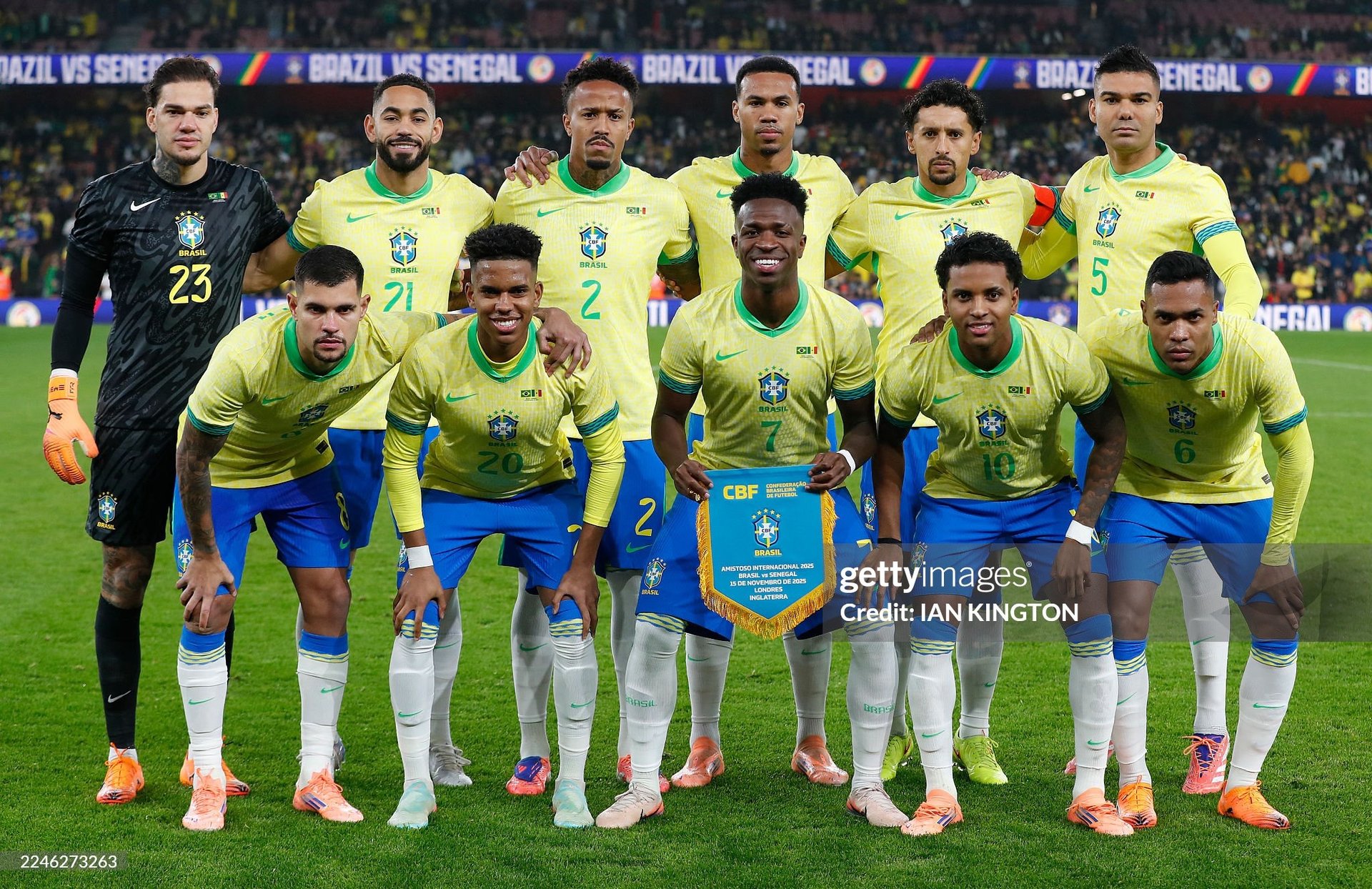
As of March 2026, Carlo Ancelotti is in the early stages of leading Brazil, having taken over in mid-2025 with limited time to establish a coherent system before the 2026 World Cup. Early signs suggest improved structure, yet the pressure is intense for him to deliver results quickly with a squad aiming for its sixth title.
The Record So Far
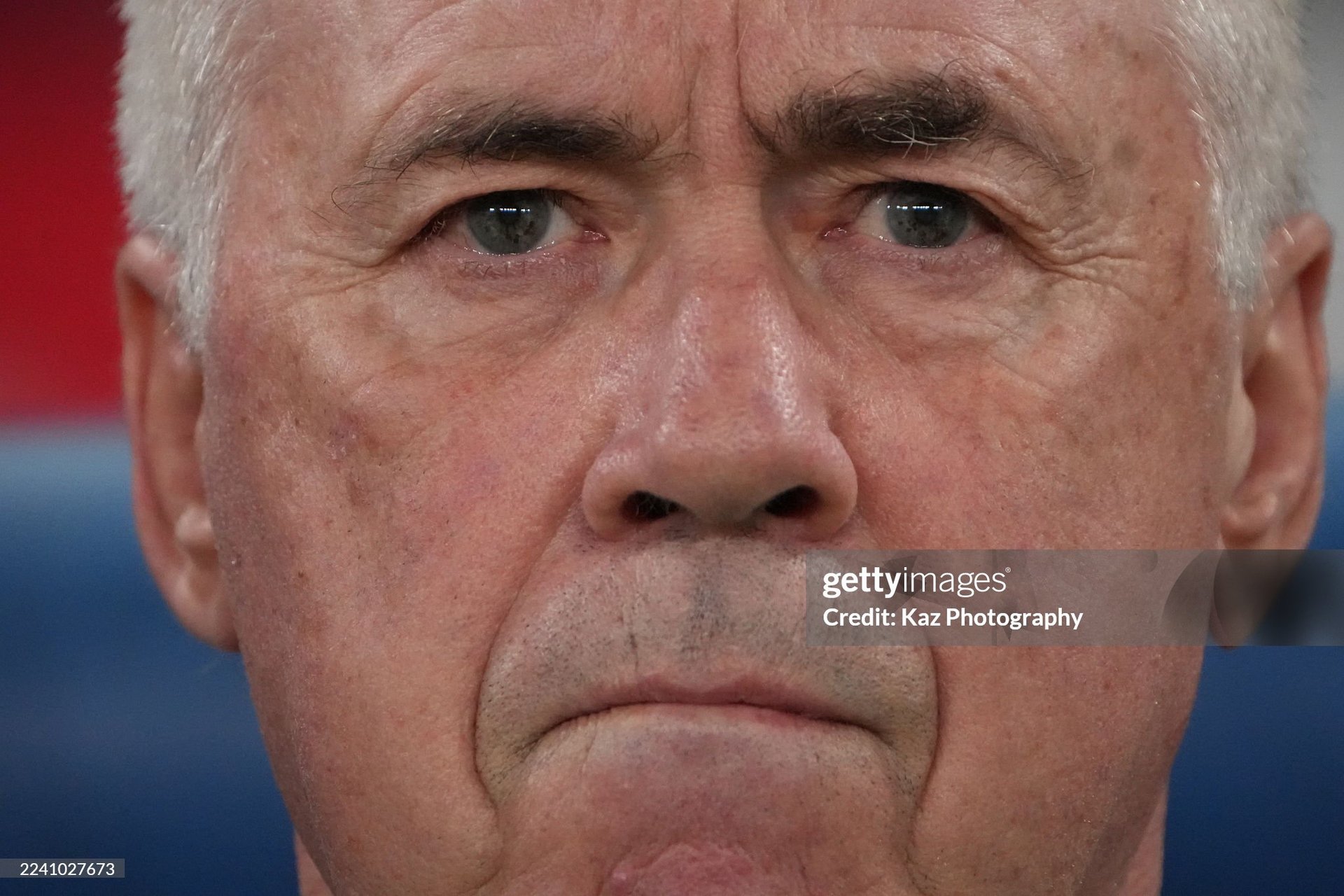
Here is what Ancelotti has done. He replaced Dorival Júnior, who was sacked after a 4-0 humiliation against Argentina and just fourteen months in charge. He took over for Brazil's final four World Cup qualifiers — drew with Ecuador, beat Paraguay 1-0 to secure qualification, beat Chile 3-0, lost to Bolivia at altitude with a heavily rotated squad. He used friendlies to experiment. Beat South Korea 5-0. Beat Senegal 2-0. Drew with Tunisia. Lost to Japan 3-2 after leading 2-0 — an alarming collapse that exposed the same defensive frailty the France match would later confirm. And now the France result itself.
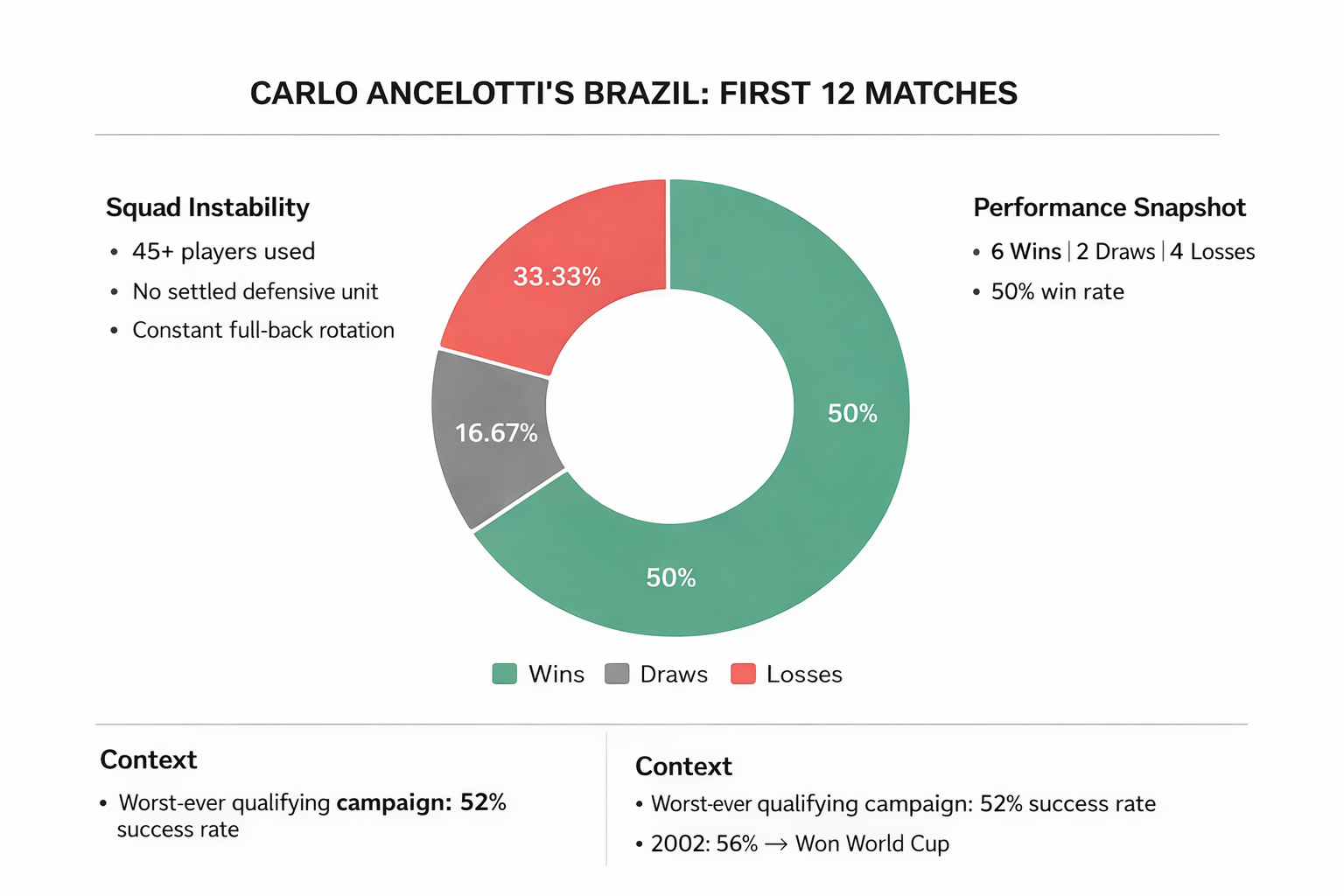
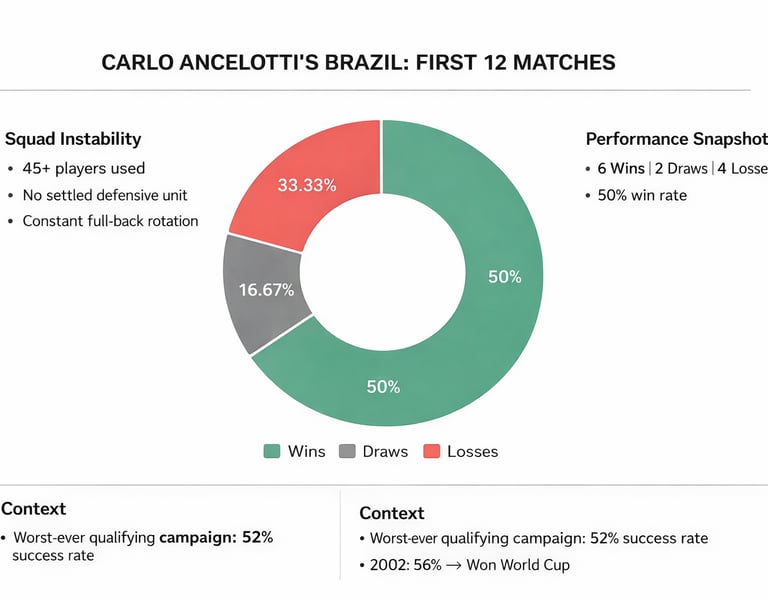
Since his appointment, Don Carlo's record so far reads as follows: played twelve, won six, drew two, lost four. His win rate sits around 50%. He has called up over forty-five different players. He has not settled on a first-choice left-back. He has not settled on a first-choice right-back. He has tested at least five or six different options at full-back and still does not appear to have a fixed defensive unit.
Brazil qualified for the 2026 World Cup. They are the only nation to have appeared at every edition since 1930. Ancelotti did not break that streak. But they finished fifth in the South American qualifying table — their worst-ever qualifying campaign, with a 52% success rate across the entire cycle. It is worth noting, with a kind of morbid irony, that their second-worst campaign — 56% in 2002 — ended with them lifting the trophy.
Statistics, in other words, will not answer this question. Only the World Cup will.
Stabilisation, Not Transformation
What Ancelotti has clearly achieved is stabilisation. Before him, Brazil were in genuine disarray. The managerial carousel had become farcical — Tite, then an interim, then Dorival Júnior, all inside a turbulent period compounded by a corruption scandal within the CBF and a change of federation president. There was no continuity, no identity, no clear idea of what Brazil were supposed to look like on the pitch.
Ancelotti ended that. He imposed a system — a 4-2-4 modelled on his second stint at Real Madrid, with no orthodox striker, four fast and skilful forwards rotating across the attacking third, wide overloads, and a double pivot anchoring possession. He brought back Casemiro, a player he knew intimately from Madrid, to provide the defensive midfield discipline the system demands. He identified Vinícius Júnior as the centrepiece of the attacking structure and began building around him. He recalled veterans who understood high-pressure environments and integrated younger talents who had earned their places through club form. There is now, at minimum, a recognisable idea of what Ancelotti's Brazil is trying to do.
The CBF is sufficiently impressed that they have entered advanced discussions to extend his contract through to the 2030 World Cup — a signal that the federation views this not as a one-tournament appointment but as a long-term project.
But here is where my conviction sharpens, and where I think the standard narrative around Ancelotti's Brazil misses the point entirely. The question is not whether Ancelotti is good enough. He is obviously good enough. The question is whether the format of international football will let him be.
The Flick Precedent
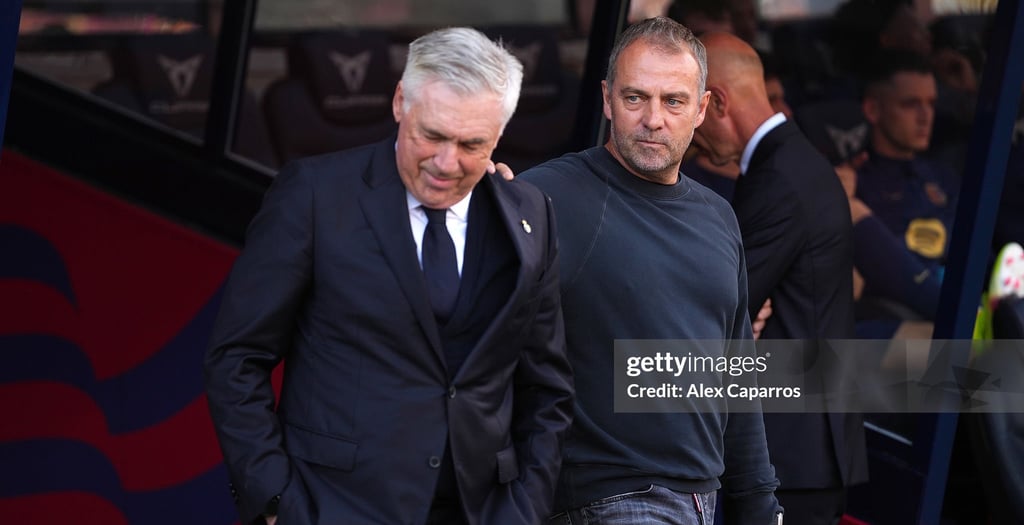
To understand what I mean, it helps to look at what happened to Hansi Flick.
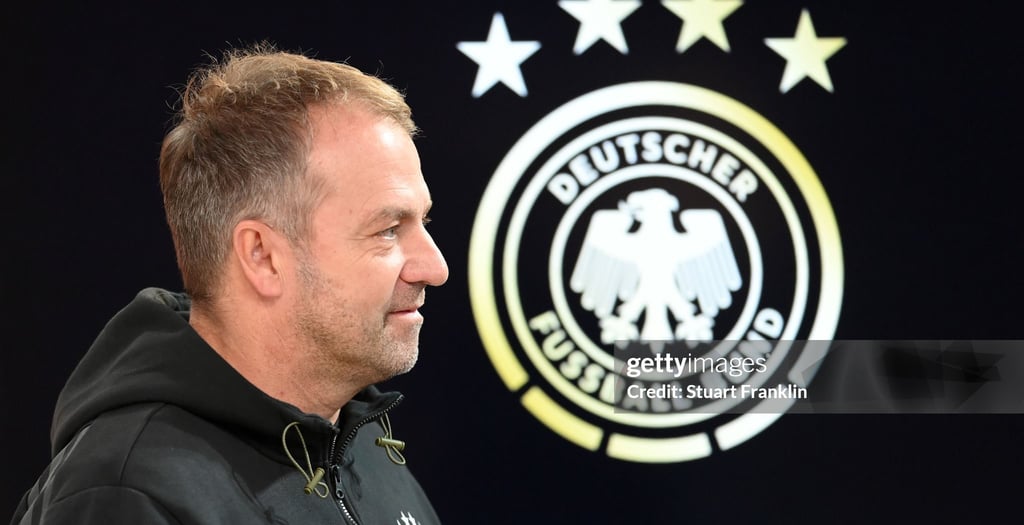
Flick's tenure as Germany head coach — from May 2021 to September 2023 — is the most instructive recent case study in the gap between club-level genius and international-level frustration.
At Bayern Munich, Flick won a sextuple in just over eighteen months. His methods were built on simplicity and sustained daily contact: settle on a formation, deploy the best players, and work relentlessly on communication to foster collective purpose. High defensive line, aggressive pressing, ride-or-die commitment to the system. It worked beautifully because he had the players to work with every single day.
Then he took the Germany job. Same 4-2-3-1. Same high line. Same gegenpressing. He won his first eight matches and qualified for Qatar with ease — but acknowledged during that run that he hadn't yet faced opponents who could genuinely test his system.
The reality check came at the 2022 World Cup. Japan exposed the flaw. Germany played their high line, relied on Neuer's sweeper-keeping, but the pressing structures that had been drilled daily at Bayern simply hadn't been replicated in sporadic international windows. Japan's halftime switch to a back three carved through Germany's shape. They lost 2-1. They were eliminated in the group stage for the second consecutive World Cup.
It didn't get better. Defeats to Belgium, Poland, and Colombia followed, and he was dismissed in September 2023 — a day after a 4–1 loss to Japan, his third straight defeat.
The critical detail — and this is the part that should keep Ancelotti and Brazil awake at night — is what Flick did next.
He went to Barcelona. Same system. Same high line. Same 4-2-3-1. In his debut season, he won La Liga, the Copa del Rey, and the Supercopa de España. Barcelona scored over a hundred league goals. The high line that Germany couldn't hold for ninety minutes became the foundation of one of the most exciting sides in European football.
Same coach. Same philosophy. Different result. The only variable that changed was the environment. At Barcelona, Flick had the players every day. The daily contact that international football had denied him was restored — and the results followed immediately.
The lesson is stark: some coaching methods are structurally incompatible with the rhythm of international football. Not because they're wrong. Because they require a volume of time that the format does not provide.
The System Without the Time
Now apply that lesson to Ancelotti's Brazil.
Ancelotti's genius has never been primarily tactical. His formations are relatively orthodox. His in-game adjustments are measured rather than revolutionary. What separates him from other elite coaches is environmental. He builds trust. He manages egos. He creates conditions where superstar players — players who have seen everything, won everything, and can be difficult to motivate — feel valued, understood, and willing to align individual instincts with the collective. At Real Madrid, this manifested as a squad that remained calm in moments where other teams panicked. The 2022 Champions League run, with its succession of improbable comebacks against PSG, Chelsea, and Manchester City, was not a tactical masterclass. It was an emotional one. Ancelotti's players believed, deeply and collectively, that they would find a way. That belief was earned over years of daily interaction — not in a pre-match team talk or a tactical briefing, but in the accumulated texture of shared experience.
How do you replicate that in ten-day international windows?
The honest answer is: you probably can't. Not fully. And the evidence from Ancelotti's tenure so far suggests that the aspects of his coaching most dependent on sustained contact are exactly the ones that haven't transferred.
His system at Brazil — the 4-2-4 with roaming forwards — requires precise coordination between the attacking line and the double pivot. When Brazil win possession high, the transitions are electric: Vinícius drives inside, Raphinha stretches the play, and the full-backs push up to create numerical advantages in wide areas. Against weaker opposition, this looks devastating. But when they lose possession against organised sides, the two holding midfielders are left exposed, the full-backs are caught high, and the defensive shape collapses. This is exactly what happened against Japan. It is exactly what happened against France. It is, I would argue, the same structural problem that Flick encountered with Germany: a system that requires synchronised defensive movement — movement that can only be made instinctive through daily repetition — failing because the players haven't had enough time together to make it second nature.
The full-back problem illustrates this perfectly. Ancelotti has tested half a dozen options across both positions and still hasn't settled on a first-choice pairing. At club level, this gets resolved in pre-season. In international football, he gets maybe four matches per window, and each window he loses players to injury and club commitments. The uncertainty at full-back isn't a failure of judgment. It's a failure of available time.
The Neymar Question Is Really a Time Question
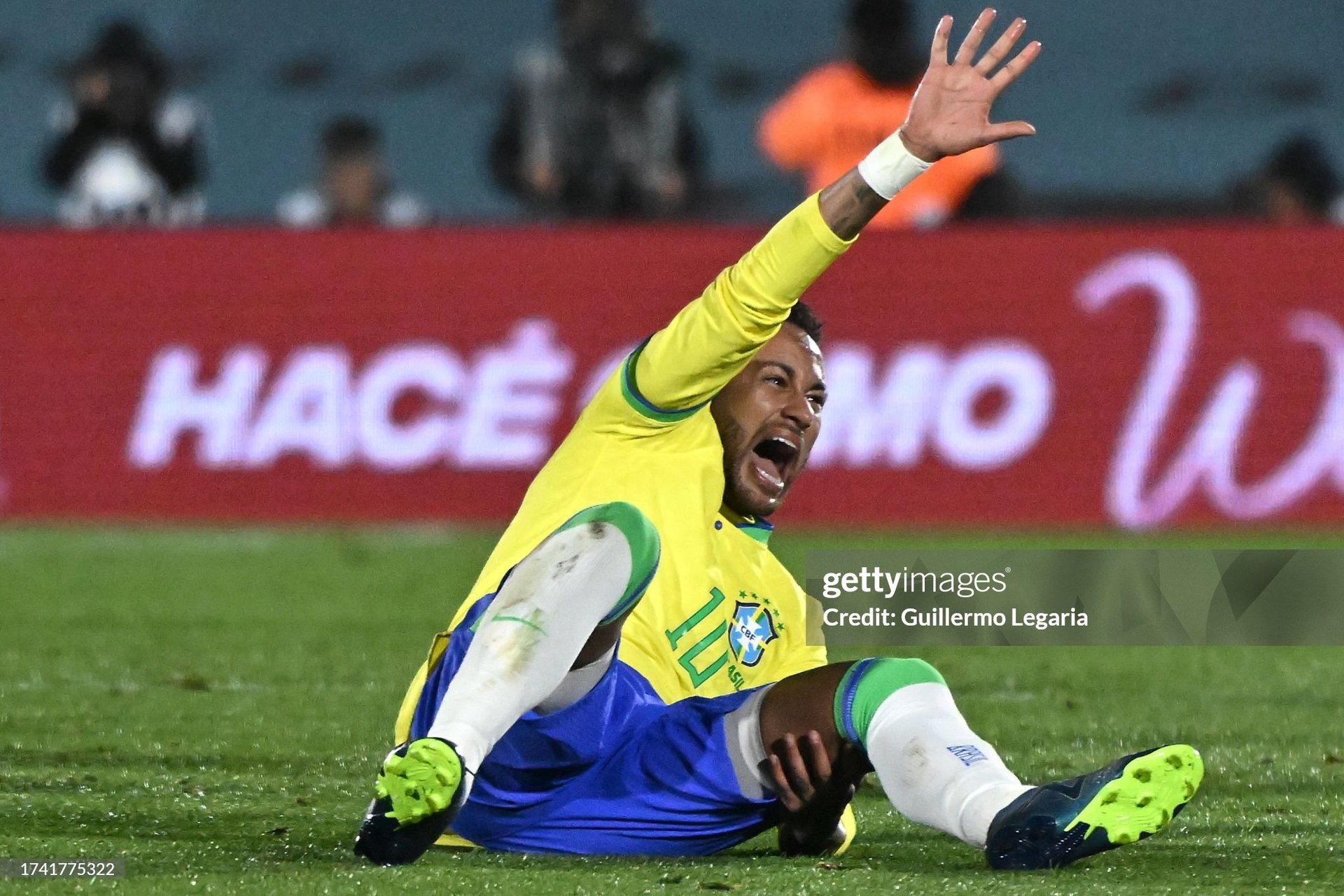
And then there is Neymar.
This is where the time problem becomes most visible, because the Neymar question is fundamentally a question about integration — and integration requires exactly the kind of sustained work that international football does not allow.
Ancelotti has been consistent and, I think, correct: fitness over legacy. He has never called Neymar up since taking the job. His position is clear. The squad belongs to players who are at 100% match intensity. In a club environment, a coach can manage a player like Neymar gradually — building his minutes over weeks, protecting him from high-risk fixtures, designing training loads around his physical limitations. At international level, you don't have that luxury. You get three or four days of preparation, then a match. If a player can't survive that rhythm — and Neymar's situation at Santos, where he can't play three games in seven days due to load management — then the risk calculus is straightforward. You can't take a player to a World Cup who might break down after the group stage.
The emotional pressure on Ancelotti has been enormous. Romario has publicly demanded he "pay attention." Vinícius Júnior has said the squad "always wants to play with the best." Neymar's father has criticised the decision. Neymar himself has responded on social media with a mixture of defiance and vulnerability, at one point suggesting he might retire at the end of the year.
But behind the soap opera is a structural reality. Even if Neymar were fit, integrating him would require time Ancelotti doesn't have — understanding how his presence alters the pressing shape, how the midfield adjusts, how Vinícius's positioning shifts. At Real Madrid, Ancelotti had months to integrate new signings. With Brazil, he would have a few days in June. The door he has left slightly ajar — "for the final list, the conversation is different" — is diplomacy, not invitation. Neymar will not be at this World Cup. And the reason is not just fitness. It is time.
The Rodrygo injury compounds everything. His ACL and meniscus tear in early March robbed Ancelotti of one of the few players he genuinely understands — over two hundred appearances together at Real Madrid, a tactical relationship that was pre-built. Losing him means losing one of the rare players who could slot into the Brazil system without adaptation. His replacement will need integration time that doesn't exist.
The Counterargument — and Why It Only Goes So Far
This is not an argument that Ancelotti will fail. Rather, it argues that the foundations of his club success — built on daily contact, accumulated trust, and environmental control — are inherently difficult to replicate in international football. The Flick precedent does not predict failure; it clarifies the mechanism behind it.
There is, however, a valid counterargument. Some coaches have succeeded in international football precisely because limited contact time compels simplification. Didier Deschamps won the 2018 World Cup with France national football team not through tactical complexity, but by constructing a pragmatic, defensively robust system that elite players could execute without extensive rehearsal. The most effective international coaches, in this sense, tend to be organisers rather than architects — prioritising clarity over intricacy, and building structures resilient enough to withstand the interruptions between international windows.
Ancelotti, to his credit, has shown signs of this adaptability. His 4-2-4 is not a complicated system on paper. His insistence on Casemiro — a player who understands his methods from years of shared work at Madrid — is a pragmatic decision that reduces the integration burden. And his emotional intelligence, his ability to make players feel calm and valued, may prove to be the quality that matters most in a World Cup environment, where the pressure is immense and the margins are tiny.
But the France match suggested that pragmatism alone may not be enough. When Brazil needed to press as a coordinated unit, they couldn't. When the system required the full-backs to hold a disciplined line while the forwards pushed high, the structure broke. These are not problems that can be solved by emotional management. They are problems that require repetition. And repetition requires time.
What Remains — and What Only the Tournament Can Answer
Brazil open their World Cup campaign against Morocco on June 13 in New Jersey — exactly the kind of organised, disciplined side that has ended Brazil's World Cup dreams in every tournament since 2002. Then Haiti. Then Scotland. The group is navigable, but it is not kind.
Between now and then, Ancelotti has the Croatia friendly, a warm-up against Egypt, and whatever training camp time the schedule allows. It is not enough to solve the full-back problem, to integrate Rodrygo's replacement, or to drill the pressing triggers the 4-2-4 demands.
The honest answer to the question at the heart of this piece: no, Ancelotti has not had enough time. The Flick precedent tells us that even the most decorated club coaches can be undone by the structural limitations of international football. But World Cups do not always reward the best-prepared team. They reward the team that holds together when things go wrong — the team with belief, composure, and the collective nerve to find a way.
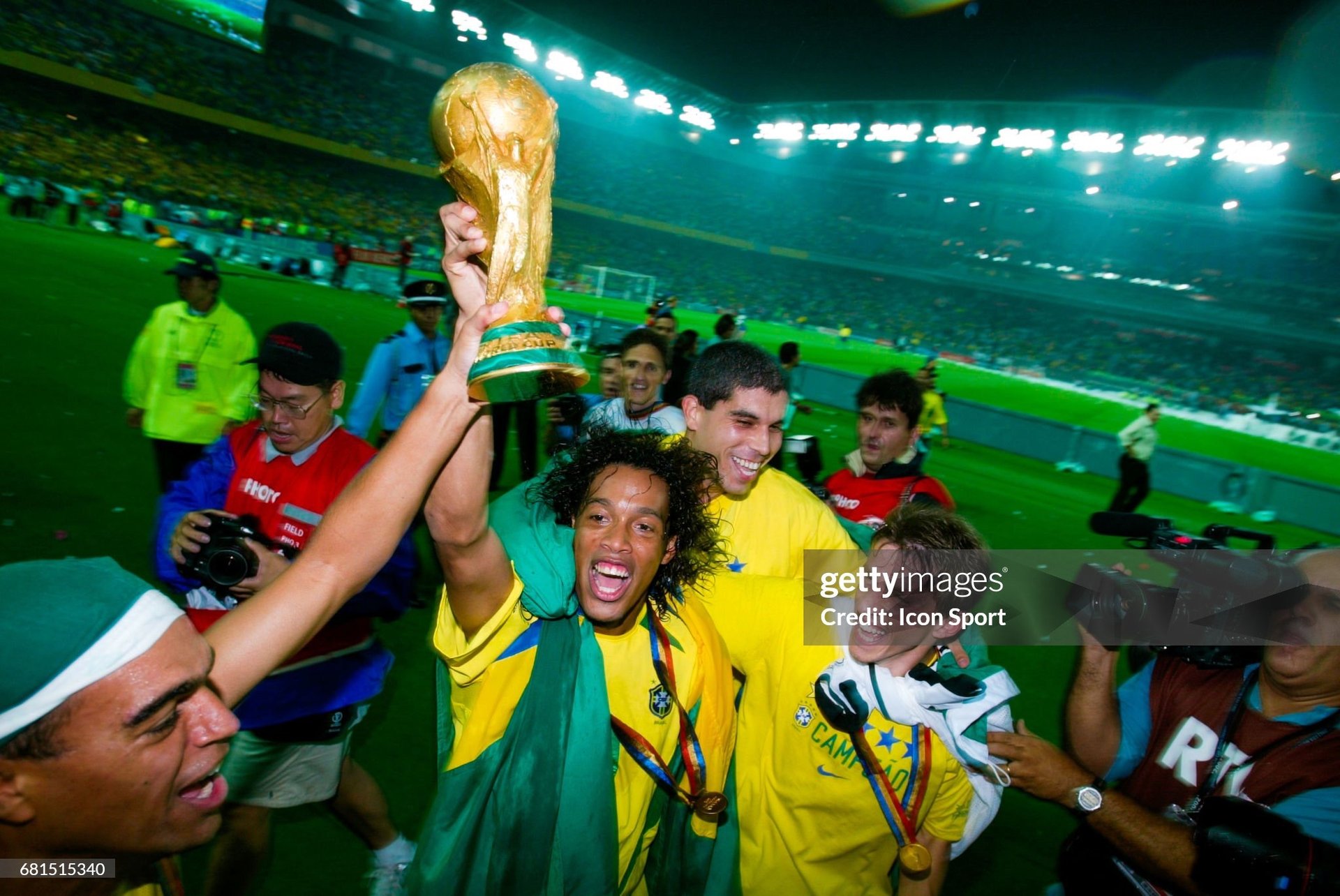
If anyone can conjure that from imperfect circumstances, it is Don Carlo. Whether it is enough for a sixth World Cup title — that, only the tournament itself will answer.
The Manner of the Defeat
Brazil lost 2-1 to France in Foxborough last week. That, on its own, is not a crisis. Friendlies are friendlies. Kylian Mbappé scored a gorgeous chip, Hugo Ekitike doubled the lead, and Bremer pulled one back after Dayot Upamecano saw red. The crowd — 66,000, overwhelmingly in yellow — booed at the final whistle.
But it wasn't the result that should concern Brazil. It was the manner.
Carlo Ancelotti set up in a 4-2-4 — Casemiro and Andrey Santos sitting, Vinícius Júnior, Gabriel Martinelli, Raphinha, and Matheus Cunha ahead of them. Four attackers. Plenty of talent. And for long stretches of the game, Brazil sat deep, couldn't press as a unit, and relied on hopeful long balls while France controlled the tempo. Ancelotti's side managed just 35% possession in the first half. Against a France team reduced to ten men, they still couldn't find an equaliser. The system that had looked devastating in a 5-0 demolition of South Korea four months earlier — the same wide overloads, the same transitional speed — fell apart against a side that was organised, compact, and drilled.
It looked, in a word, like a team that hadn't spent enough time together.
The Weight of the Appointment
When Carlo Ancelotti was appointed Brazil head coach in May 2025, it was treated as a seismic moment. And it was. In over a century of international football, the Confederação Brasileira de Futebol - CBF had entrusted only three non-Brazilians with the job — and those three managed a combined seven games. The last was Argentine Filpo Nunez, who took charge for a single match in 1965. For sixty years after that, the position belonged to Brazilians and Brazilians alone.
The decision to hire Ancelotti represented something more than a coaching appointment. It was an admission. Brazil's football dominance had eroded steadily across two decades, and despite two Copa América titles in 2007 and 2019, the metric that matters — the World Cup — had delivered nothing but disappointment. Every campaign since 2002 had ended the same way: elimination at the hands of a European side in the knockout stages. The hoodoo had calcified into something approaching an identity crisis. The logic, then, was blunt: if you want to beat European teams, hire the man who built the best of them.
Ancelotti arrived with credentials that made the appointment almost unquestionable. Five Champions League titles. Domestic league success in Italy, England, France, Spain, and Germany. A reputation — earned over decades — for getting the very best out of elite players, for managing egos without conflict, and for building dressing room cultures where superstars felt trusted enough to perform under pressure. At Real Madrid, his teams didn't just win trophies. They won them with a collective emotional composure that seemed to elevate every player in the squad. That was the quality the CBF was buying. A Brazil side that had crumbled under expectation and pressure — in Belo Horizonte against Germany in 2014, against Belgium in 2018, against Croatia in 2022 — needed someone who could steady the ship before the storm.
So. Has he had enough time?